The Partnership of AgData.
Preserving the planet is a global responsibility, and meaningful progress can only be achieved through strong, coordinated collaboration. Within the AgData Partnership, we work closely with organizations, research institutions, governmental bodies, and industry stakeholders from across the world to advance sustainable agricultural practices and respond effectively to increasing climate threats. By combining expertise, sharing data, and aligning strategies, the partnership creates a powerful foundation for innovation and long-term resilience.
With a 300 million EUR budget, the initiative supports large-scale projects focused on digital transformation, climate adaptation, and environmentally responsible food production. Its 61 partners (55 beneficiaries, 3 affiliated entities and 3 associated partners) from 22 countries bring together diverse skills and perspectives—from Earth observation scientists and data specialists to farmers’ associations and policymakers—ensuring that solutions are both practical and scientifically robust.
The AgData Partnership fosters international knowledge exchange and strengthens cooperation across borders. This wide network accelerates the development of digital tools, promotes common data standards, and helps regions with differing capacities benefit equally from technological advancements.
Together, these joint efforts enable the agriculture and food sectors to better anticipate risks, implement more sustainable practices, and contribute to a healthier and more resilient planet.

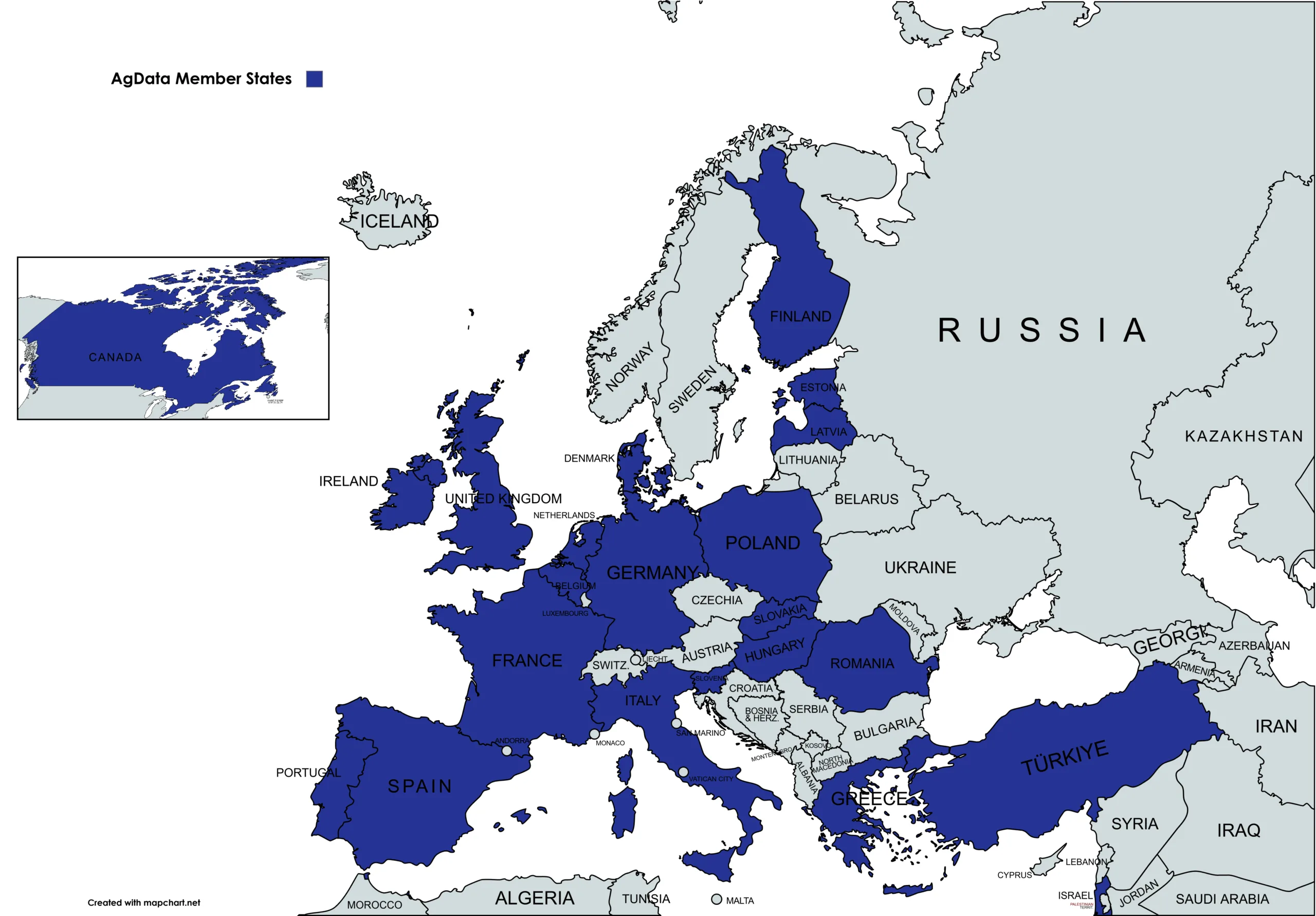
Our Partners

AGTAE, Denmark: STYRELSEN FOR GRON AREALOMLAEGNING OG VANDMILJO
UCPH, Denmark: KOBENHAVNS UNIVERSITET
FZ-Juelich, Germany: FORSCHUNGSZENTRUM JULICH GMBH
BLE, Germany: Bundesanstalt für Landwirtschaft und Ernährung
WR, The Netherlands: STICHTING WAGENINGEN RESEARCH
AEI, Spain: AGENCIA ESTATAL DE INVESTIGACION
MASA, France: MINISTERE DE L’AGRICULTURE ET DE LA SOUVERAINETE ALIMENTAIRE
CNR, Italy: CONSIGLIO NAZIONALE DELLE RICERCHE
UEFISCDI, Romania: UNITATEA EXECUTIVA PENTRU FINANTAREA INVATAMANTULUI SUPERIOR A CERCETARII DEZVOLTARII SI INOVARII
EV ILVO, Belgium: EIGEN VERMOGEN VAN HET INSTITUUT VOOR LANDBOUW- EN VISSERIJONDERZOEK
TEAGASC, Ireland: AGRICULTURE AND FOOD DEVELOPMENT AUTHORITY
PTSpace, Portugal: AGENCIA ESPACIAL PORTUGUESA – PORTUGAL SPACE
AU, Denmark: AARHUS UNIVERSITET (AU)
MASAF, Italy: MINISTERO DELL’AGRICOLTURA, DELLA SOVRANITA’ ALIMENTARE E DELLE FORESTE
FCT, Portugal: FUNDACAO PARA A CIENCIA E A TECNOLOGIA
IGN, France: INSTITUT NATIONAL DE L’INFORMATION GEOGRAPHIQUE ET FORESTIERE
ASP, France: AGENCE DE SERVICE ET DE PAIEMENT
PSNC, Poland: INSTYTUT CHEMII BIOORGANICZNEJ POLSKIEJ AKADEMII NAUK
UMA, Spain: UNIVERSIDAD DE MALAGA
MMM, Finland: MAA- JA METSATALOUSMINISTERIO
LVVN, The Netherlands: MINISTERIE VAN LANDBOUW, VISSERIJ, VOEDSELZEKERHEID EN NATUUR
WU, The Netherlands: WAGENINGEN UNIVERSITY (WU)
CSIC, Spain: AGENCIA ESTATAL CONSEJO SUPERIOR DE INVESTIGACIONES CIENTIFICAS
INRAE, France: INSTITUT NATIONAL DE RECHERCHE POUR L’AGRICULTURE, L’ALIMENTATION ET L’ENVIRONNEMENT
CAPADR, Spain: CONSEJERIA DE AGRICULTURA , PESCA, AGUA Y DESARROLLO RURAL
IFD, Denmark: INNOVATIONSFONDEN
ARIB, Estonia: POLLUMAJANDUSE REGISTRITE JA INFORMATSIOONI AMET
REM, Estonia: REGIONAAL- JA POLLUMAJANDUSMINISTEERIUM
ETAG, Estonia: SIHTASUTUS EESTI TEADUSAGENTUUR
JKI, Germany: JULIUS KUHN-INSTITUT BUNDESFORSCHUNGSINSTITUT FUR KULTURPFLANZEN
JSI, Slowenia: INSTITUT JOZEF STEFAN
ZALF, Germany: LEIBNIZ-ZENTRUM FUER AGRARLANDSCHAFTSFORSCHUNG e.V.
ATB, Germany: LEIBNIZ-INSTITUT FUR AGRARTECHNIK UND BIOOKONOMIE e.V.
GRNET, Greece: NATIONAL INFRASTRUCTURES FOR RESEARCH AND TECHNOLOGY
NOA, Greece: ETHNIKO ASTEROSKOPEIO ATHINON
BPI, Greece: BENAKI PHYTOPATHOLOGICAL INSTITUTE
FWO, Belgium: FONDS VOOR WETENSCHAPPELIJK ONDERZOEK-VLAANDEREN
DAFM, Ireland: DEPARTMENT OF AGRICULTURE, FOOD AND THE MARINE
TAIGHDE, Ireland: TAIGHDE EIREANN RESEARCH IRELAND
ICBF, Ireland: IRISH CATTLE BREEDING FEDERATION SOCIETY LTD
MUR, Italy: MINISTERO DELL’UNIVERSITA E DELLA RICERCA
LAAFS, Latvia: LATVIJAS LAUKSAIMNIECIBAS UN MEZA ZINATNU AKADEMIJA BIEDRIBA
NKFIH, Hungary: NEMZETI KUTATASI FEJLESZTESI ES INNOVACIOS HIVATAL
CDTI, Spain: CENTRO PARA EL DESARROLLO TECNOLOGICO Y LA INNOVACION E.P.E.
CREA, Italy: CONSIGLIO PER LA RICERCA IN AGRICOLTURA E L’ANALISI DELL’ECONOMIA AGRARIA
TUBITAK, Turkey: TURKIYE BILIMSEL VE TEKNOLOJIK ARASTIRMA KURUMU
UGUELPH, Canada: UNIVERSITY OF GUELPH
IIA, Israel: NATIONAL TECHNOLOGICAL INNOVATION AUTHORITY
VITO, Belgium: VLAAMSE INSTELLING VOOR TECHNOLOGISCH ONDERZOEK N.V.
FRS-FNRS, Belgium: FONDS DE LA RECHERCHE SCIENTIFIQUE- FNRS
SPW, Belgium: SERVICE PUBLIC DE WALLONIE
RRes, UK: ROTHAMSTED RESEARCH LTD
THUENEN, Germany: JOHANN HEINRICH VON THUENEN-INSTITUT, BUNDESFORSCHUNGSINSTITUT FUER LAENDLICHE RAEUME, WALD UND FISCHEREI
ARO, Israel: THE AGRICULTURAL RESEARCH ORGANISATION OF ISRAEL – THE VOLCANI CENTRE
CVTI-SR, Slovakia: CENTRUM VEDECKO TECHNICKYCH INFORMACII SLOVENSKEJ REPUBLIKY
Associated Partners
BMFTR, Germany: BUNDESMINISTERIUM FUR FORSCHUNG, TECHNOLOGIE UND RAUMFAHRT
BMLEH, Germany: BUNDESMINISTERIUM FUR LANDWIRTSCHAFT, ERNAHRUNG UND HEIMAT
MOAG, Israel: MINISTRY OF AGRICULTURE AND FOOD SECURITY
Affiliated Entities
FECYT, Spain: FUNDACION ESPANOLA PARA LA CIENCIAY LA TECNOLOGIA, F.S.P.
LUKE, Finland: LUONNONVARAKESKUS
FFA, Finland: RUOKAVIRASTO
Coordinator: Agency for Green
Transition and Aquatic Environment
Email: agdata@sgav.dk
Co-funded by the European Union. Views and opinions expressed are however those of the author(s) only and do not necessarily reflect those of the European Union or European Research Executive Agency (REA). Neither the European Union nor the granting authority can be held responsible for them.